
From First Principles to Practice: How to Classify Digital Assets Under GAAP & IFRS
Where our unified checklist meets real-world classification.

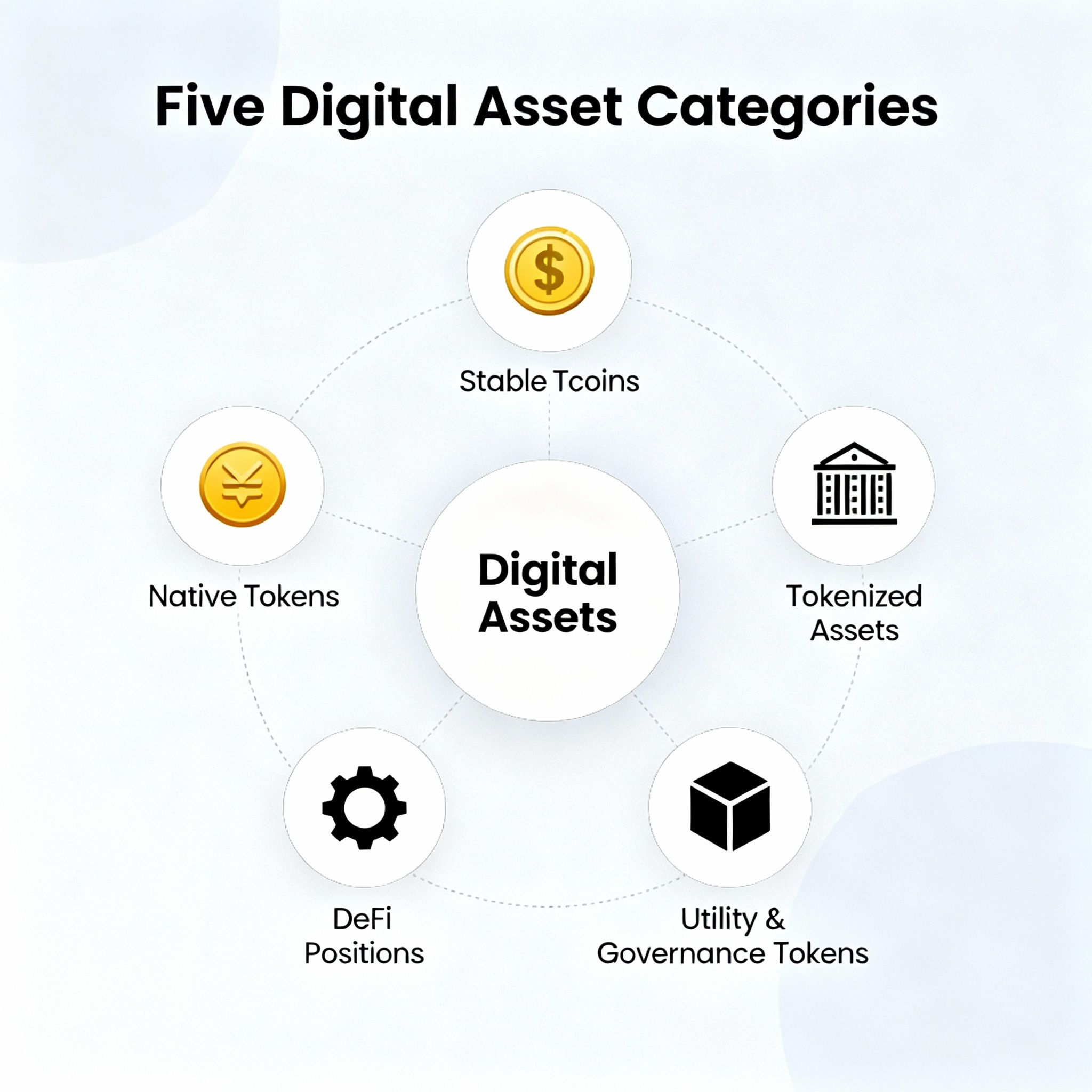
In the last two posts, we sketched the two pillars of this series: first, the five-category map that makes the digital-asset universe intelligible; and second, the unified accounting classification model; a practical decision tree built from first principles. This post brings those two threads together.
Instead of adding more theory, we’re stepping into the assets themselves. My goal here is simple: to show you how the model actually works in practice, highlight how GAAP and IFRS diverge (and why that matters), and do it all in a way that feels accessible. Think of this one as the moment the framework gets tested in the wild.
Classification by the Five Digital Asset Categories
A. Native Tokens (BTC, ETH, etc.)
Definition: The core cryptocurrency that powers a blockchain’s operations (i.e., BTC on Bitcoin or ETH on Ethereum). Unlike secondary tokens built on top, native tokens are integral to the blockchain’s foundation.
Cash Equivalent? Almost never. Extreme volatility, no redemption guarantees.
Financial Asset?
GAAP: Typically not, because native tokens lack an identifiable counterparty or enforceable claim.
IFRS: Could be financial if specific contractual rights exist, rare in practice.
Inventory? Usually no, unless held for sale in ordinary course (rare).
Intangible Asset? Yes. Indefinite-lived.
ASU 2023-08 Impact: Updates fair value measurement and disclosure, but not classification.
Interpretive Gaps: Valuation techniques vary; custody arrangements complicate reporting.
Auditor Pain Points: Market price sourcing, impairment triggers.
Regulatory Blind Spots: No guidance for decentralized, non-issuer tokens.
Teaser: Here’s a dedicated post that offers a deeper dive into native tokens.
B. Stablecoins (USDC, USDT, PYUSD)
Definition: Digital assets pegged to fiat or other collateral.
Cash Equivalent? Rare; depends on liquidity, redemption rights, and reserve backing.
Financial Asset?
GAAP: Possibly if redeemable.
IFRS: similar, may meet financial instrument criteria.
Inventory? Possible if held for operational sale.
Intangible Asset? Default if no redemption claim.
ASU 2023-08 Impact: Applies for measurement and disclosure.
Interpretive Gaps: Reserve verification, counterparty risk, redemption rights (Tether, USDC).
Auditor Pain Points: Verification of backing, enforceability of redemption claims.
Regulatory Blind Spots: Reserve audits, disclosure consistency.
Teaser: Here’s a dedicated post that offers a deeper dive into stablecoins.
C. Tokenized Assets (Tokenized real estate, equities, commodities)
Definition: Real-world or traditional financial assets represented digitally on a blockchain, giving them easier transferability, fractional ownership, and programmable features.
Cash Equivalent? Rarely.
Financial Asset?
GAAP: Likely, if the token clearly conveys a contractual claim on an underlying financial asset (e.g., equity, debt, or ownership interest).
IFRS: Even more likely than GAAP; IFRS takes a substance-over-form approach, so if the tokenized instrument mirrors a financial instrument economically, it generally meets the financial asset definition.
Inventory? Possible if held for sale.
Intangible Asset? Default if no enforceable claim.
ASU 2023-08 Impact: Measurement rules apply; classification usually unchanged.
Interpretive Gaps: Legal enforceability, custody, settlement mechanics.
Auditor Pain Points: Determining underlying rights, reconciling blockchain vs legal record.
Regulatory Blind Spots: Securities law overlaps; cross-border tokenized assets.
Teaser: Here’s a deep dive on tokenized assets.
D. Utility & Governance Tokens (UNI, APE, protocol tokens)
Definition: Utility and governance tokens give users access to a platform’s features and the ability to vote on its decisions or future development.
Cash Equivalent? No; value depends on network utility or governance power.
Financial Asset?
GAAP: Only if the token embeds a contractual right to cash, another financial instrument, or economic returns; this is rare because most governance or utility rights are non-contractual.
IFRS: Similar conclusion, but IFRS is more permissive where governance rights confer substantive decision-making power that can influence cash flow returns; even then, most tokens still fail financial instrument criteria.
Inventory? Rare, unless company sells for revenue.
Intangible Asset? Default for most use cases.
ASU 2023-08 Impact: Applies for measurement and disclosure if held by an entity.
Interpretive Gaps: Revenue recognition, network maturity, governance rights.
Auditor Pain Points: Determining economic substance; usage vs investment.
Regulatory Blind Spots: Oversight of network-driven rights.
Teaser: This post explores utility and governance tokens fully
E. DeFi Positions (LP tokens, staking, yield instruments)
Cash Equivalent? No; liquidity and redemption are protocol-dependent.
Financial Asset?
GAAP: Possible, but difficult. Most DeFi instruments do not provide a legally enforceable claim against an identifiable counterparty, which GAAP typically requires.
IFRS: Slightly more flexible. IFRS focuses on economic rights rather than formal legal enforceability, so if the protocol structure creates a contractual right to receive cash or another financial asset, classification may be possible.
Inventory? Rare.
Intangible Asset? Default in most cases.
ASU 2023-08 Impact: Measurement guidance applies; classification generally unaffected.
Interpretive Gaps: Synthetic yield, rehypothecation, protocol risk.
Auditor Pain Points: Fair value, exposure, protocol solvency.
Regulatory Blind Spots: Standardized reporting, risk disclosures.
Teaser: DeFi positions are unpacked here, with the decision frameworks treasurers and auditors typically rely on.
Where Guidance Is Missing (Interpretive Challenges)
This is the frontier where classification debates frequently occur, and where regulators inevitably look for direction. These aren’t problems we solve today, but naming them matters.
1. No clarity on stablecoin reserves and how that affects classification
Stablecoins claim to be backed by real-world assets (like cash or T-bills), but there’s no uniform rule for proving it. Some stablecoin issuers provide monthly reports, others quarterly summaries, and others provide only high-level disclosures. Many of these reports are not full audits, and different issuers use different standards, definitions, and methodologies.
Why this matters for accounting:
Whether a holder can classify a stablecoin as a financial asset depends on having a clear, enforceable right to redeem the underlying reserves, yet today’s reserve attestations are voluntary, inconsistent, and often unaudited. Accounting classifications hinge on enforceability: if redemption rights rely on opaque attestations, can a holder truly assert a financial asset claim?
Furthermore, finance teams operate on inferred trust not auditable evidence. This is a structural problem that undermines both GAAP and IFRS classification models. Until assurance practices are standardized, stablecoins will continue to sit awkwardly in a gray zone, part-cash, part-intangible….
2. No GAAP category for synthetic assets (liquid staking tokens, wrapped tokens)
Liquid staking tokens and wrapped assets are crypto’s version of modern-day stand-ins:
A liquid staking token is like giving your friend your car to rent out, and in return they hand you a “receipt that earns mileage points” while your actual car stays locked up.
A wrapped token is like taking a bar of gold, sealing it in a vault, and receiving a “voucher” you can freely trade instead of lugging the gold around.
Economically, these instruments behave like interest-bearing or convertible financial products: they generate returns, track an underlying asset, or function as a transferable claim. But legally and technically, they are still just intangible digital receipts, with no traditional issuer, contract, or enforceable promise behind them.
Why this matters for accounting:
U.S. GAAP has no dedicated category for this entire class of assets, so accountants are forced into an uncomfortable workaround: They apply legacy intangible-asset guidance to instruments that act like financial assets but look like software objects on a ledger.
This growing misalignment between economic substance and blockchain form is one of the most glaring gaps in current accounting literature, and standard-setters haven’t yet addressed it.
3. Lack of enforceability standards for tokenized claims
Tokenization promises fractional ownership and real-world asset exposure, but in practice, tokenized rights are only as enforceable as the legal wrapper behind them. Many tokenized instruments use SPVs, trusts, or contractual schemas that vary dramatically in quality.
Why this matters for accounting:
Under both GAAP and IFRS, enforceability determines whether the token is a financial asset or simply an intangible. Right now, there is no common enforceability baseline, leaving auditors to make judgment calls that differ widely by issuer.
4. DeFi positions are not addressed under any existing asset category
DeFi instruments (i.e., LP tokens, staking receipts, vault tokens) generate returns, confer claims, and expose holders to counterparty risk, but none fit cleanly within GAAP’s current definitions. They are too fluid to be cash equivalents, too decentralized to be financial assets, too market-linked to be pure intangibles, and too technical to be inventory.
The result?
Preparers and auditors rely on analogies, not explicit guidance; an unstable foundation for a market with billions in locked value.
5. Unresolved tension between economic substance and blockchain mechanics
This is one of the deepest theoretical problems: Should classification follow the asset’s economic behavior, or the blockchain structure that represents it?
Examples:
A wrapped token acts like the underlying asset, but legally, no direct claim exists.
A governance token can influence cash flows but offers no contractual right.
A synthetic token can deliver returns but has no counterparty.
GAAP prioritizes legal form; IFRS prioritizes substance. Digital assets routinely split those two apart, and current guidance doesn’t reconcile the gap.
6. Auditors applying inconsistent classification across clients
Because the standards lag reality, auditors rely heavily on firm-level interpretation memos, which rarely align: A token treated as a financial asset in one audit may be treated as an intangible in another.
This impacts comparability, earnings volatility, liquidity reporting, and even creditworthiness. Until standard-setters provide a unified framework, audit outcomes will remain uneven, which undermines investor confidence.
7. Need for clearer delineation between “crypto assets” vs “crypto-linked rights”
A crypto asset (e.g., BTC) is fundamentally different from a crypto-linked right (e.g., tokenized equity, yield-bearing receipts, staked positions). Yet today, both tend to collapse into the same “intangible asset” bucket unless narrow financial instrument criteria are met.
This blurs economic reality and forces accountants to flatten distinctions that matter for liquidity, impairments, and solvency. A separation similar to “physical commodities vs commodity contracts” may eventually be needed.
Disclaimer: The content in this newsletter is for general informational purposes only and does not constitute individualized legal, financial, tax, accounting, or investment advice. Although I am a qualified professional, the analysis provided is not tailored to any specific entity or situation. No warranty is made as to the accuracy or completeness of the information, and no liability is accepted for actions taken based on it.
Didn't expect this angle, but you really hit the mark on those asset clasifications. So insightful.